
Some places can be explained; Hughenden is a place that needs to be felt – from the vastness of the sky and the colour the rock turns at sunset to the calm that settles in once you’re a few kilometres off the highway. Flinders Shire is a landscape shaped by contrast: the sheer red walls of Porcupine Gorge, rocky basalt terrain, and flat, open grazing plains stretching out towards the horizon. Slow down and take it all in – here’s how to make the most of it.
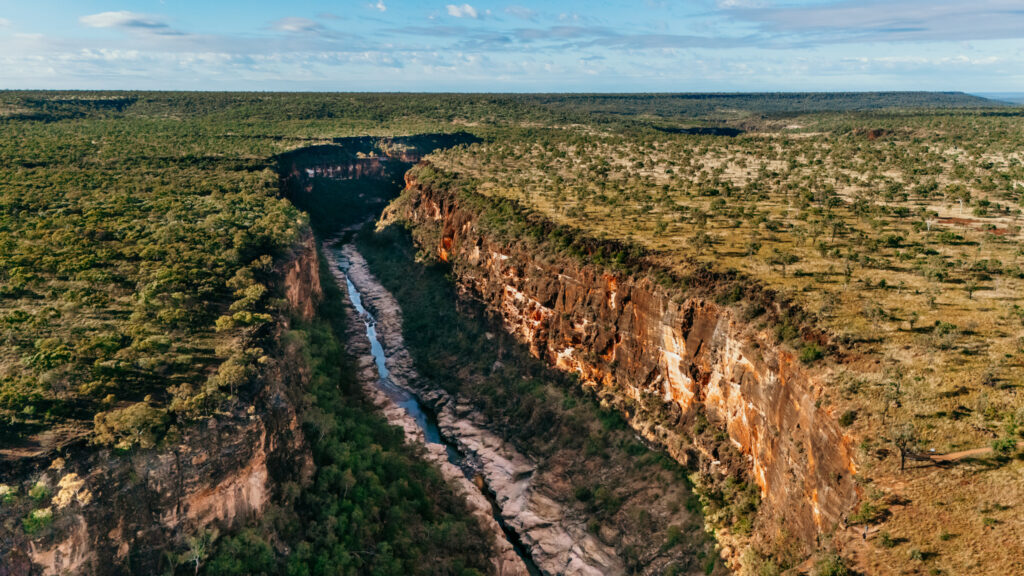
Porcupine Gorge: A Landscape Hundreds of Millions Of Years in The Making
Porcupine Gorge is one of Hughenden’s most popular attractions, and once you’re standing at the rim looking down, it’s easy to see why. The gorge exposes sandstone laid down long before dinosaurs walked this part of the country – around 500 million years ago! Its walls are stacked with layers of deep red, rust and cream, each telling a different chapter of the region’s geological past. To really appreciate what’s in front of you, head to the Flinders Discovery Centre in town, where the screening room brings millions of years of geological history and the changing landscape to life. While you’re there, it’s worth picking up their points-of-interest map too, which flags a few smaller lookouts along the drive to the gorge that are easy to miss!
Back at the gorge itself, what’s quite remarkable is the natural stillness that makes you want to stop a moment and take it all in. No visitor centre, no crowded car park, no coach trips trudging through, just you, the quiet and the scale of it all.
And there’s more than one way to experience it. The Rim Walk is an easy, 30-minute flat walk each way from the Pyramid camping area, perfect for those after sweeping views without the climb. The Pyramid Track takes you right down into the gorge itself, past waterholes and up close to the colourful sandstone cliffs. It takes roughly 30 minutes to get down and 40-60 minutes to get back up (depending on your fitness level). However you choose to experience it, Porcupine Gorge is one of those places that stays with you long after you’ve left.
White Mountains National Park: A Different Kind of Vast
Where Porcupine Gorge is dramatic and vertical, White Mountains National Park is wide and open – pale sandstone country stretching in every direction, changing colour with the light. Early morning turns the sandstone soft and pink; by mid-afternoon it’s bleached almost white, which is exactly where the park gets its name. Burra Range Lookout, right on the Flinders Highway, is the easiest spot to take in that view. If conditions and vehicle access allow and you’ve got a 4WD, Sawpit Gorge Lookout is well worth the detour.
White Mountains is one of Hughenden’s quieter attractions, and also one of Queensland’s most botanically diverse parks, home to everything from eucalypt and acacia woodlands to sweeping heathland. Keep an eye on the rocks and spinifex grasses too – this is prime reptile territory, and you might spot a frilled lizard or a knob-tailed gecko sunning themselves along the way. As we head into the wet season, a good bit of rain transforms this vast, arid landscape – streams start flowing again, feeding into rivers that eventually reach as far as the Gulf of Carpentaria and Lake Eyre in South Australia. For the full picture of what’s growing and living out here, the Flinders Discovery Centre has a complete species list worth checking out.
A quick note before you go: White Mountains is remote and largely untracked, so it suits experienced, well-equipped bushwalkers who are confident navigating and self-sufficient out here. If that’s not you, the drive-in lookouts still offer plenty of the park’s scenery without venturing off-track.


The Country in Between
The country between Hughenden’s major natural attractions is part of the experience, and the Basalt Byway is a perfect example. If you’ve got the time, the right vehicle, and suitable conditions, take the slower route through volcanic plains and rocky ridgelines. Along the way, the roads cut through grazing country that gives way to rockier terrain: flat-topped ranges on the horizon and cattle grazing calmly across the plains – you’ll likely spot a few curious Brahmans with their floppy ears watching you pass. Kangaroos and wallabies are common at dawn and dusk, and it’s worth looking up too, with wedge-tailed eagles and other birds of prey often circling overhead.
Distances feel bigger out here, and that’s not a downside – it’s part of what makes the scenery worth the trip. Find a safe place to stop as the sun drops, take in the orange glow spreading across the horizon, and stay for the star-filled sky that inevitably follows.
Stargazing in Hughenden
Away from the glow of larger cities, Hughenden offers wonderfully dark skies for stargazing. Mount Walker Lookout, just outside Hughenden, is one of the easiest and most rewarding Hughenden attractions to visit. Pack a picnic, get there before sunset, and stay for the stars. If you’re after something more isolated, pull over at a lookout or rest area out of town, where the sky gets even darker and the stars even brighter.
Read more tips on stargazing in Hughenden here.

Why the landscape is worth building a trip around
Hughenden attractions aren’t just for hardened hikers or nature purists – there’s something here for everyone. Whether it’s a sunrise walk around Hughenden’s lake, the hike down into Porcupine Gorge, a slow drive out to White Mountains, an afternoon spotting wildlife along the Basalt Byway, or a picnic under the stars at Mount Walker, there’s a way to experience this landscape that suits your style!
Start planning your trip to Hughenden and discover a part of outback Queensland that’s still peaceful, still uncrowded, and still entirely its own.